
Een bekende , voor meneer van der Weide, Japanse historicus is Dr. Chikatsu Hayashi(1961) uit Japan
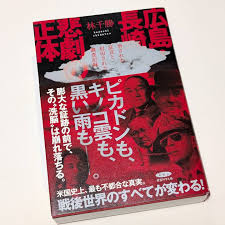
Zijn uitleg (ook in boekvorm te verkrijgen , alleen in het Japans)
” The Truth Behind the Definitive Hoax Revealed by Primary Sources and Scientific Data ”
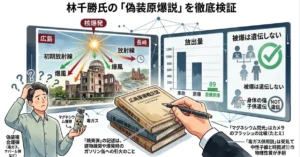
In recent years, on the internet and certain platforms, we have increasingly seen the surprising theory (the Fake Atomic Bomb Theory) that “what was dropped on Hiroshima and Nagasaki was not an atomic bomb, but a ‘composite bomb’ where the U.S. military faked an atomic bomb.” being circulated.This theory is enthusiastically advocated by Chisato Hayashi, known as a researcher of modern history. According to Mr. Hayashi, the true nature of the atomic bomb is “a combination of magnesium flash bombs, thermobaric bombs, napalm bombs, poison gas, and radioactive waste.” he claims.
At first glance, this theory is presented as a “hidden truth,” but when compared with physical and historical facts—referencing excellent verification video series on YouTube—it has been revealed to be a complete hoax (misinformation) riddled with fundamental misreadings and scientific ignorance.In this article, we will thoroughly refute why Mr. Hayashi’s claims are 100% wrong, using five key points.
💡 Refutation 1: The “magnesium” in the “Atomic Bomb War Disaster Records” is merely a metaphor for a camera flash
Mr. Hayashi uses the fact that the word “magnesium” appears many times in the official “Hiroshima Atomic Bomb War Disaster Records” (5 volumes), compiled by the Hiroshima City Office, as his primary evidence, claiming, “This is proof that the ‘pika’ (flash) of the ‘pika-don’ was a magnesium flash bomb (a conventional weapon).”However, if you examine all the actual documents, the truth becomes clear immediately. What is written there is nothing more than a “metaphor” used by survivors to describe the tremendous light of the atomic bomb.
-
Original text from the documents: “Saw a flash similar to a magnesium flash”, “A bluish-white flash like burning magnesium occurred”
From the Meiji era until some time after the war, the synonym for “an intense artificial light that makes your vision go completely white in an instant” in general society was “magnesium flash (the flash device of an antique camera).” People at the time, in order to convey the intense flash of the nuclear explosion they had seen for the first time in their lives to others, used everyday language to compare it, saying, “It was like the light of a photographer’s magnesium.”This was common Japanese usage, appearing in literary works from the Meiji and wartime periods (writings by Kan Kikuchi, Tatsuo Hori, and Yukio Mishima), where “burning magnesium” was used quite normally to mean “taking a photograph.” Mr. Hayashi is making an embarrassing misreading, claiming “a magnesium bomb was dropped” without knowing this historical context or the vocabulary of the Japanese language.
📝 Refutation 2: Malicious cutting and pasting of “gasoline” and “incendiary bombs” while ignoring context
Mr. Hayashi also cites the same documents and says, “There is evidence that the U.S. military mixed in conventional incendiary bombs and scattered gasoline.”However, this is also a big lie. No matter where you look in the documents, there is not a single line of record stating that “the U.S. military scattered gasoline as a composite bomb.”The context written in the actual documents is as follows.
-
“During the war, in preparation for air raids like those in other cities, citizens were taking measures against incendiary bombs (such as building evacuations).”
-
“Due to the heat rays of the atomic bomb, fires broke out when gasoline cans located in various parts of the city caught fire.”
Mr. Hayashi is simply conveniently extracting only the words “gasoline” and “incendiary bomb” from the text, completely ignoring the context before and after, and fabricating a story that this is “proof that the atomic bomb is a lie.”
🧪 Refutation 3: Why were people able to live there so soon? The decisive difference between a “nuclear power plant accident” and an “atomic bomb”
A question often raised by Mr. Hayashi’s supporters is, “Chernobyl and Fukushima still have restricted access, but Hiroshima and Nagasaki were rebuilt and people were able to live there immediately. Therefore, the atomic bomb must be a lie, and it must have been a conventional bomb that didn’t emit radiation.”It may seem like a sharp question at first glance, but this is a misunderstanding stemming from scientific ignorance that ignores the structural differences between a “nuclear power plant accident” and an “atomic bomb”.Let’s compare the absolute amounts of radioactive material released into the environment (using Cesium-137 as the measurement standard).
-
Hiroshima Atomic Bomb: A mere 89 Terabecquerels
(*The Nagasaki atomic bomb was even less, at 74 Terabecquerels)
In a nuclear power plant accident, tens of tons of nuclear fuel continue to burn for days and months, gradually scattering massive amounts of radioactive material.
On the other hand, the amount of uranium and plutonium that actually underwent nuclear fission in the Hiroshima and Nagasaki atomic bombs was less than 1 kg (about the size of a single brick).
The purpose of an atomic bomb is not to “contaminate the surroundings with radioactivity over a long period,” but to “unleash an order of magnitude greater explosive power in an instant.” Because the amount of radioactive material scattered from the beginning was infinitesimally small compared to a nuclear power plant accident, the fact that the areas became habitable again quickly is a 100% physically and scientifically natural phenomenon.
⚡ Rebuttal 4: The cause of atomic bomb disease is “initial radiation,” not poison gas
Mr. Hayashi further develops his own theory: “If there is so little radioactivity, why do people get atomic bomb disease (radiation sickness)? Therefore, the U.S. military must have used poison gas as well.”
This, too, can be refuted by the basics of physics. The greatest cause of atomic bomb disease is not the contaminants left in the air, but directly bathing in the intense “initial radiation” released at the moment of the explosion (the flash).People who were directly exposed to the powerful “gamma rays” and “neutron rays” released at the moment of the explosion developed specific acute radiation sickness (atomic bomb disease), such as internal organ damage and hair loss, even if they had no external injuries at the time.
Furthermore, invisible neutron rays collide with soil on the ground and concrete in buildings, acting to temporarily turn those substances into radioactive materials (induced radioactivity/residual radioactivity). This induced radioactivity has the physical property that approximately 80% disappears within the first 24 hours, and it becomes almost completely zero after two weeks. That is precisely why the “entering survivors” who went in to help on the day of the bombing were exposed, while the rescue teams that entered later suffered no harm. Conventional weapons like poison gas can never explain this rapid decay of radioactivity over time.
🚨 Rebuttal 5: The biggest contradiction. Trying to “reassure second and third-generation survivors” actually affirms left-wing hoaxes
Mr. Hayashi says, “I want to reassure the second and third-generation survivors who are suffering from worries about the heredity of atomic bomb disease. I was thanked when I told them that it wasn’t an atomic bomb, so please rest assured.”However, this line of reasoning contains an extremely serious self-contradiction.
Saying “there is no worry about heredity because it wasn’t an atomic bomb” means, conversely, that Mr. Hayashi himself is affirming the incorrect premise that “atomic bomb disease (the effects of radiation) is hereditary to the next generation”.
Scientific Conclusion;
As a result of decades of massive follow-up surveys by Japanese and American specialized institutions (such as the Radiation Effects Research Foundation), no genetic effects (such as increased cancer incidence or mortality rates) due to the parents’ exposure have been found at all in the children (second and third generations) of survivors. The current firm scientific conclusion is that no matter how much damage somatic cells receive from radiation, it is not inherited by children.
If you truly want to reassure second and third-generation survivors from the bottom of your heart, the correct message to deliver is, “Please rest assured because there is scientific fact that the effects of the atomic bomb are not inherited by the next generation,” rather than feeding them a false conspiracy theory that says, “Atomic bomb disease is so terrifying that it is hereditary. But don’t worry, that atomic bomb was a fake made of conventional bombs.”
Mr. Hayashi’s argument, as a result, reinforces the fear propaganda favored by some radical anti-nuclear movements that “radioactivity is inherited like a curse for generations to come,” and it must be said that this is a very harmful discourse.
🏁 Summary
Chikatsu Hayashi’s “composite bomb theory (fake atomic bomb theory)” may look like intellectual and sensational content that doubts existing history at first glance, but in reality, it is
-
Misreading of contemporary Japanese expressions (camera flash)
-
Convenient cherry-picking that ignores the context of primary sources
-
Confusion and misunderstanding of scientific data regarding atomic bombs and nuclear power plants
—this is a hoax that is worthless both physically and historically, created through these means.
While the stance of exposing the darkness of history is important, we must always face objective facts and scientific evidence rather than being misled by emotional performances or conspiracy theories created by cherry-picking words.
📚 References and Videos
-
YouTube Video: Verification and Rebuttal Series of Chikatsu Hayashi’s “Atomic Bomb Hoax” (Videos produced by Mr. Miyazaki / Mr. Misu)
-
Hiroshima City Hall, “Hiroshima Atomic Bomb War Disaster Records,” 5 volumes
-
Radiation Effects Research Foundation (RERF) Official Data
-
Ministry of the Environment, “On the Genetic Effects of Radiation” Official Document